NepalAustralia.club
|
International Business Research Brief
Nepal–Australia Economic Gateway
From 65+ Years of Partnership to
Premium Trade, Education,
Clean Technology, Tourism
and Indo-Pacific Connectivity.
International Business Strategy Brief
September 2026
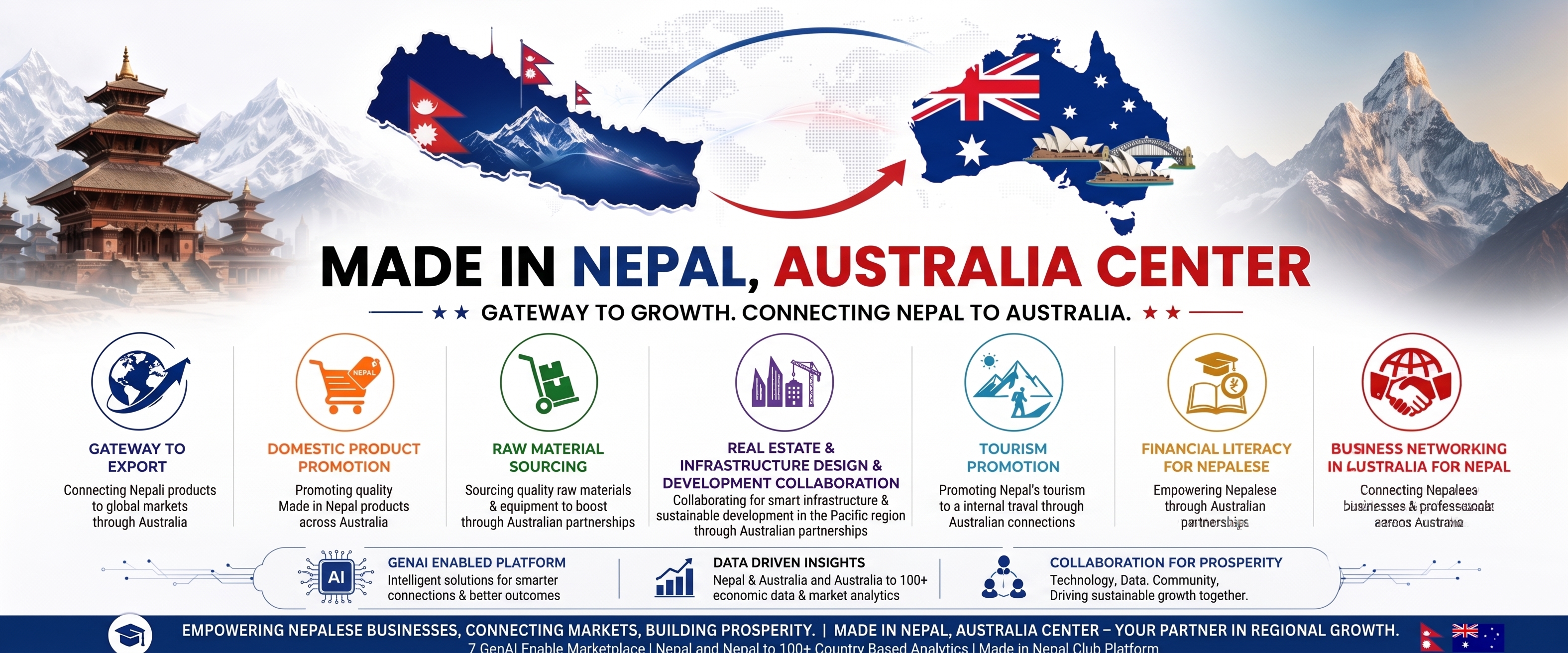
Made in Nepal, Australia Center
Gateway to Export •
Domestic Product Promotion •
Raw Material Sourcing •
Real Estate & Infrastructure
Design & Development Collaboration •
Tourism Promotion •
Financial Literacy for Nepalese •
Business Networking in Australia for Nepal
65+ Years of Partnership.
A New Commercial Chapter.
Nepal and Australia established diplomatic
relations on 15 February 1960.
Their relationship now spans development
cooperation, education, trade,
investment, tourism, agriculture,
water resources and a rapidly growing
people-to-people network.
The Trade and Investment Framework
Arrangement (TIFA), signed in February 2024,
created a formal platform for commercial
engagement.
Its first Joint Nepal–Australia Trade
and Investment Committee meeting was held
in Kathmandu in July 2026.
Australia's 2025 goods-and-services exports
to Nepal were about A$4.587 billion,
while imports from Nepal were
A$351.4 million.
Education-related travel accounted
for A$4.235 billion.
The Commercial Opportunity
Building a Nepal–Australia
Economic Connectivity Platform
NepalAustralia.club can organize
export development, sourcing,
infrastructure, tourism,
financial capability and business networking
around seven strategic pillars.
1
Gateway to Export — Nepal to Australia
Australia offers premium niches for
Nepalese carpets, wool and felt products,
pashmina, apparel, tea, coffee,
essential oils, handmade paper,
handicrafts, specialty foods
and wellness products.
Nepal is currently listed by Australian
Border Force as a Least Developed Country
beneficiary, and Australia's tariff-preference
system provides duty- and quota-free access
for qualifying LDC-origin goods.
Exporters should build certification,
traceability, Australian labeling,
importer relationships, landed-cost discipline
and e-commerce readiness.
Market Research and Feasibility Study On:
Gateway to Export — Nepal to Australia
View Market Research
→
2
Domestic Product Promotion
Made in Nepal promotion should combine
English-language storytelling,
diaspora retail, craft and food festivals,
specialty stores, tourism-linked retail
and digital commerce.
The brand proposition should emphasize
Himalayan provenance, craftsmanship,
natural ingredients, ethical production,
sustainability and authenticity.
Australia already supplies Nepal
with oilseeds, vegetables,
refined petroleum and industrial inputs.
Higher-value sourcing can extend into
agri-tech, food-processing systems,
water-resource technology,
mining and construction equipment,
environmental services,
research technology
and renewable-energy solutions.
ACIAR and CSIRO are already active
in Nepal on agricultural productivity
and natural-resource management.
Real Estate & Infrastructure
Design & Development Collaboration
The July 2026 bilateral mechanism
highlighted climate resilience,
green economy, water-resource management
and hydropower investment.
Commercial opportunities include
renewable energy, smart grids,
water systems, climate-resilient
urban infrastructure, hotels,
student housing, logistics,
disaster-risk systems
and sustainable construction.
Market Research and Feasibility Study On:
Real Estate & Infrastructure
Design & Development Collaboration
View Market Research
→
5
Tourism Promotion — Australia to Nepal
Nepal welcomed 49,357 Australian visitors
in 2025—up 12.2% from 2024
and 26.6% above 2019.
Priority products include trekking,
mountaineering, wildlife,
wellness, culture, photography,
visiting-friends-and-relatives travel
and premium responsible adventure.
Diaspora marketing,
specialist tour operators
and better air-connectivity options
can increase arrivals and spending.
Market Research and Feasibility Study On:
Tourism Promotion — Australia to Nepal
View Market Research
→
6
Financial Literacy for Nepalese
Australia's large Nepal-linked community
makes this pillar economically significant.
Financial education should cover
AUD/NPR exposure, banking,
budgeting, remittances,
emergency savings, superannuation,
taxation awareness, insurance,
student finance, responsible investing,
entrepreneurship and business finance.
SMEs also need trade-finance,
landed-cost and cross-border
payment knowledge.
NepalAustralia.club can connect
Nepalese exporters, Australian importers,
universities, agri-tech and clean-tech firms,
investors, tourism operators,
professionals, students
and diaspora entrepreneurs.
Commercial development should operate
nationally and at city/state level
across Sydney, Melbourne, Brisbane,
Perth, Adelaide and Canberra.
Verified directories,
buyer-seller meetings,
TIFA-linked industry dialogue,
investment introductions
and sector-specific feasibility studies
can transform people-to-people ties
into measurable business.
Market Research and Feasibility Study On:
Business Networking in Australia for Nepal
View Market Research
→
Australia's bilateral trade with Nepal
is overwhelmingly services-led.
In the 2025 DFAT fact sheet,
Australian exports to Nepal totaled
A$4.587 billion,
of which A$4.235 billion
was education-related travel.
Australia imported A$351.4 million
from Nepal, including A$296 million
in recreational travel.
Nepal's students and migrants
are therefore not simply consumers
of Australian services.
They can become future founders,
buyers, investors,
technology adopters,
tourism ambassadors
and market connectors for Nepal.
The 2024 TIFA
and the first Joint Trade
and Investment Committee meeting
in July 2026 provide
an institutional channel
for addressing trade barriers,
investment opportunities
and private-sector cooperation.
International Business Strategy
NepalAustralia.club should position Australia
as a multi-directional economic partner:
a premium market for Made in Nepal,
a source of agricultural
and environmental technology,
a green-infrastructure collaborator,
a high-value tourism market
and one of Nepal's most important
education/diaspora-linked
business ecosystems.
Turning Nepal–Australia Partnership
Into Measurable Economic Opportunity
NepalAustralia.club
can become a practical gateway
connecting Nepalese producers,
entrepreneurs, tourism operators
and investment opportunities
with Australian buyers,
universities, technology providers,
investors, institutions
and diaspora networks.
Research & Information Disclaimer:
This page is intended for general business,
trade, tourism, investment
and educational information.
It does not constitute financial,
investment, banking, customs,
tax, immigration, legal
or other regulated professional advice.
Tariff preference treatment can change
with country classification and legislation.
Businesses should verify current tariff status,
regulations, standards,
logistics costs and counterparties
before transactions or investments.
Research Published by
A-Raj Sarraf, USA
,
Supervised by
The Raj Sarraf, USA